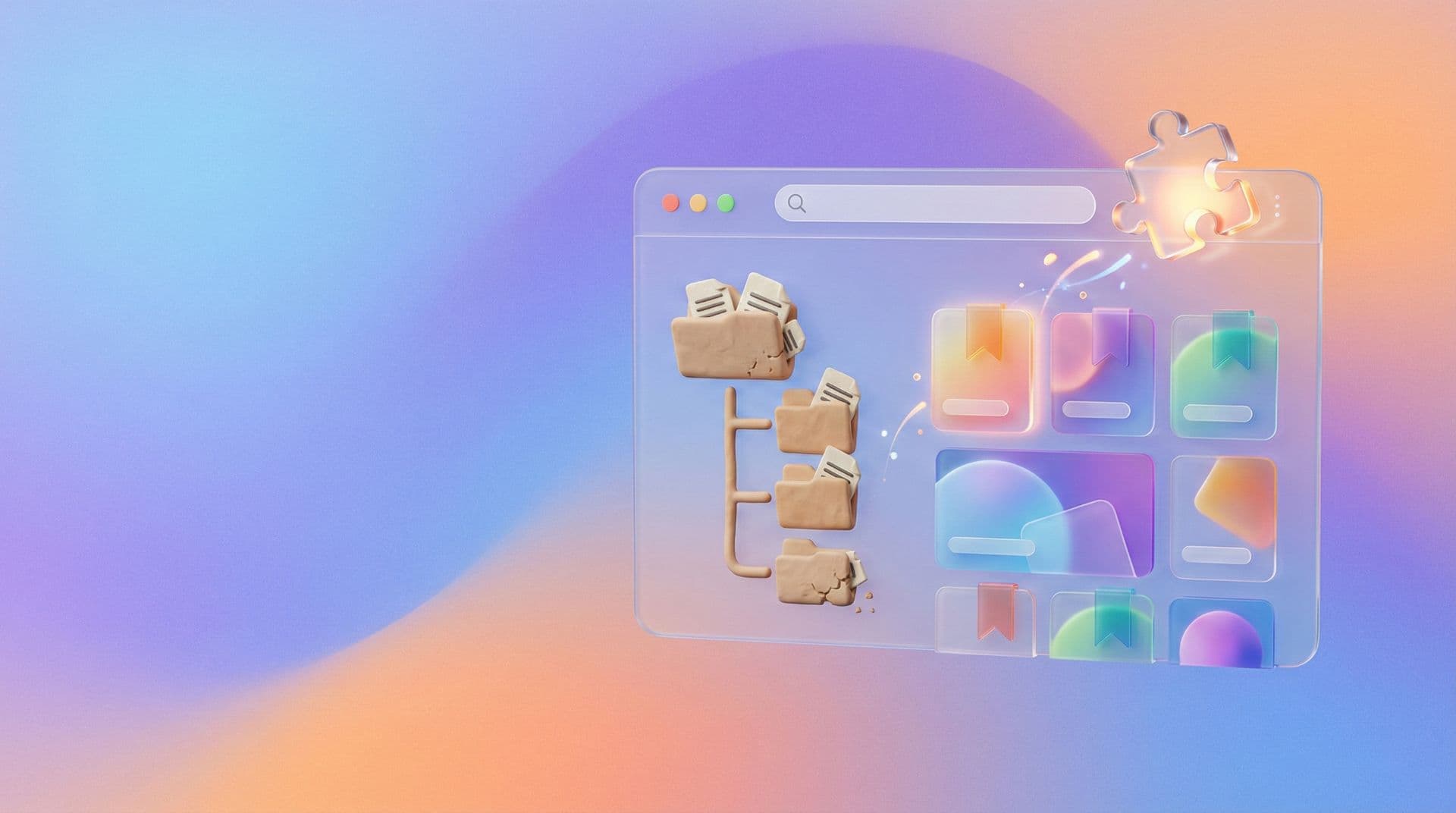
Best Bookmark Manager for Chrome in 2026: Save Smarter, Find Faster
Chrome runs most of the internet. Its bookmark system runs on a folder tree from 2008.
That gap? These extensions close it — and one of them closes it so completely you'll forget Chrome's native manager exists.
Chrome's Bookmarks Were Never Built for You
The world's most-used browser ships with a search bar that stutters, folders you'll never name right, and zero visual context for anything you've saved. You've bookmarked hundreds of pages. You can find maybe twelve of them.
That's not a workflow. That's a graveyard.
The average Chrome user has over 200 saved bookmarks and can actively recall fewer than 10% of them. The problem isn't that you're saving the wrong things — it's that the tool was never designed to help you find them again. No thumbnails. No smart tags. No search that reads your intent. Just a flat list and a folder hierarchy that made sense in 2008, when people bookmarked ten pages a week instead of ten a day.
The good news: Chrome's extension ecosystem built what Google didn't. Here are the four extensions worth your time — and one that's worth making your default right now.
Quick Comparison
| Extension | Best For | Free Tier | Import from Chrome |
|---|---|---|---|
| Markify | Everyone — daily browsing | ✅ Yes | ✅ Yes |
| Raindrop.io | Power users & researchers | ✅ Yes | ✅ Yes |
| Save to Pocket | Article & long-form readers | ✅ Yes | ✅ Yes |
| Toby | Tab hoarders & project workers | ✅ Yes | ✅ Yes |
1. Markify — Best Overall Chrome Bookmark Extension
The verdict: Markify is the bookmark manager Chrome always should have been.
Visual cards. Auto-generated tags. Search that actually surfaces the page you're thinking of — in under a second. You click the extension, it saves. No menus. No folders to navigate. No friction between you and the thing you want to save.
Four months of daily use and Chrome's native bookmark manager stays closed. That's the test that matters.
What Makes It Different
Most bookmark tools ask you to do the work — name the bookmark, choose a folder, add tags manually. Markify does it for you. It pulls the page title, grabs a visual thumbnail, and auto-generates tags based on content category. Save a recipe and it gets tagged as food. Save a GitHub repo and it lands under development. Your library organises itself while you keep browsing.
The search is the real revelation. Type a word — any word you associate with the page — and Markify surfaces it instantly. You don't need to remember what you named it. You don't need to remember which folder you filed it under. You just need to remember that you saved it.
Who It's For
Everyone. If you bookmark more than five pages a week, Markify is the upgrade your browser has needed for years. It's fast enough for casual users, smart enough for researchers, and clean enough that you'll actually want to use it.
Why it's first: Speed that feels instant. Organisation that builds itself. A UI so clean that saving a bookmark becomes something you actually do — not something you keep meaning to get around to.
👉 Try Markify free — no credit card required
2. Raindrop.io — Best for Power Users
Control without chaos. That's the Raindrop promise — and it delivers.
Right-click context menu for saving without breaking your flow. Customisable keyboard shortcuts so your hands never leave the keyboard. Drag-and-drop organisation that snaps into nested collections exactly where you want them. Raindrop is feature-dense in the best possible way — every capability deliberate, none of them decorative.
What Makes It Different
Raindrop goes further than most managers on organisation depth. You can nest collections inside collections, build smart filters that auto-sort saves by domain or tag, and annotate individual bookmarks with highlights and notes. Researchers, writers, and anyone managing large reference libraries will feel it snap into their workflow immediately.
The cross-platform sync is seamless. Save on Chrome at your desk, access it from Safari on your iPhone, pick it up on Firefox at the office. Everything lives in one place regardless of what device you're on.
The free tier handles most needs. The Pro plan — at $3/month — unlocks full-text search inside saved pages, meaning you can search the contents of a page you saved, not just its title. For researchers, that's transformative.
Who It's For
Power users. Researchers. Anyone who wants their bookmark manager to work exactly the way their brain does — and doesn't mind spending five minutes configuring it to get there.
3. Save to Pocket — Best for Article Readers
One button. One click. Saved.
Pocket strips saving down to its most elemental form. No folders. No tags unless you want them. No decisions at the moment of saving — just a clean queue of everything you want to read, waiting for you whenever you have the time.
What Makes It Different
The reading experience is what sets Pocket apart from every other tool on this list. Save an article cluttered with ads, sidebars, and autoplay videos — open it in Pocket and you get clean text, adjustable font size, and zero distractions. It's the difference between reading and fighting your way through a page.
The mobile handoff is effortless. Save something on Chrome at your desk, open Pocket on your phone on the commute home, and it's right there — even offline. Pocket syncs your reading queue across every device automatically, and downloaded articles load without a connection.
Who It's For
Long-form readers. Newsletter skimmers. Anyone who ends every day with twelve open tabs they meant to read and never did. Pocket clears the tabs and holds the articles — no excuses left.
4. Toby — Best for Tab Management
Your new tab page, reimagined as a workspace.
Toby replaces Chrome's default new tab with a visual board that lets you save entire sessions — every open tab, grouped and named, ready to restore in a single click. Stop losing your research context when your laptop dies. Stop reopening twenty tabs one by one every Monday morning. Toby keeps your sessions intact so you can pick up exactly where you left off.
What Makes It Different
The visual layout is genuinely better than any other tab manager available. Drag cards between columns, rename groups, colour-code by project. It's the kind of organisation that makes a busy browser feel manageable instead of overwhelming.
Toby also has a team sync feature — shared collections your whole team can access and contribute to. If you're coordinating research, curating resources for a project, or keeping a shared reading list, Toby makes it collaborative without making it complicated.
Who It's For
Tab hoarders. Project-based workers. Anyone who lives in their browser and wants their workspace to reflect that — organised, visual, and always ready.
Five Chrome Bookmark Habits Worth Keeping
Clear the bar ruthlessly. The bookmarks bar should hold your seven most-visited sites — nothing more. If you haven't clicked something in a month, it's not a shortcut. It's clutter.
The Omnibox is already searching your bookmarks. Start typing in Chrome's address bar. Your saved pages surface automatically alongside search suggestions. Most users never realise it. Now you do.
Export quarterly. Open
chrome://bookmarks, hit the three-dot menu, and select Export Bookmarks. One minute of your time — complete insurance for everything you've ever saved.Name bookmarks before you need them. The default title Chrome grabs is often the page headline — specific enough to find later. The habit of saving without renaming is what makes bookmarks findable six months down the line.
Use folders as projects, not categories. "Design" is a category. "Homepage Redesign — March 2026" is a project. Folders that map to current work get used. Folders that map to vague topics get abandoned.
Frequently Asked Questions
Does Markify replace Chrome's built-in bookmarks?
No — and it doesn't need to. Markify works alongside Chrome's native system without touching it. Use Chrome's bookmarks bar for the five sites you visit every day. Use Markify for your full collection — the pages you actually want to find again weeks or months from now.
Is Markify free?
Yes. Markify has a free tier that covers everything most users need — visual saving, auto-tagging, and instant search. No credit card required to get started.
Do bookmark extensions slow Chrome down?
Lightweight ones don't. Markify, Pocket, and Toby are built to stay invisible when you're not actively using them. They consume negligible memory and add no perceptible load to Chrome's performance. The rule: if an extension runs a constant background process, it'll show up in Chrome's Task Manager. These don't.
Can I import my existing Chrome bookmarks into Markify?
Yes, in under a minute. Go to
chrome://bookmarks, click the three-dot menu, and select Export Bookmarks — Chrome saves your entire library as an HTML file. Open Markify, go to Settings → Import, and upload that file. Everything transfers: titles, URLs, folders. Nothing gets left behind.Which is better — Markify or Raindrop.io?
Depends on how you work. Markify is faster to set up, easier to use daily, and handles the 80% use case beautifully — save fast, find fast, zero maintenance. Raindrop.io goes deeper on power features: nested collections, full-text search inside saved pages, and granular annotation tools. Start with Markify if you want something that works immediately. Graduate to Raindrop if you find yourself wanting more control.
Does Pocket work on mobile?
Yes — and the mobile experience is actually Pocket's strongest feature. Save on Chrome on desktop, read on iPhone or Android on the go. Articles download for offline reading automatically. It's the smoothest read-it-later flow available across any platform.
Can I share bookmarks with my team?
Toby is the best option for team sharing — its shared collections feature was built specifically for collaborative workspaces. Raindrop.io also supports shared collections on its Pro plan. Markify and Pocket are primarily personal tools.
What's the best free bookmark manager for Chrome?
All four tools on this list have solid free tiers. But if you want the best free experience with no restrictions on core functionality, Markify delivers the most for zero cost — visual cards, auto-tagging, and instant search, all free, with no artificial limits to push you toward a paid plan.
The Bottom Line
Chrome's built-in bookmarks aren't going anywhere. But they were never built for the way you actually browse in 2026 — saving fast, searching by feel, and picking up a thread from three weeks ago without losing twenty minutes hunting for it.
These four extensions fix that. Each one excels in a specific lane. Together, they cover every kind of browser and every kind of workflow.
But if you only install one today, make it Markify. It handles the core job — save it, find it later — better than anything else available for Chrome. Setup takes thirty seconds. The payoff starts immediately.
The best bookmark manager is the one you actually use. This is that one.
Start with Markify — it's free →
Thanks for reading!
Read more articles